
Linux Certification Guide: Choose the Right Path
Compare LFCS, RHCSA, Linux+ and LPIC-1 by role, exam format and vendor focus, then choose the Linux certification path that fits the work you want to do.
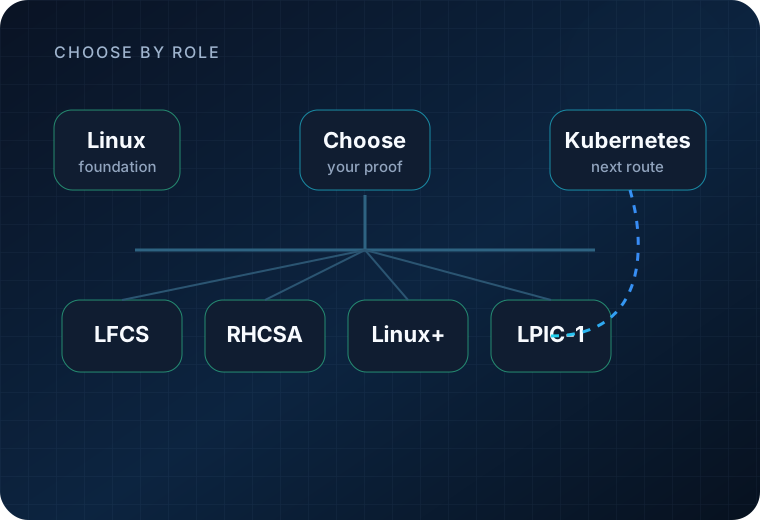
If you want a vendor-neutral, hands-on Linux system administration credential, LFCS is a strong fit. If your target is specifically Red Hat Enterprise Linux, RHCSA is the more direct choice. Linux+ covers broad Linux administration, security, automation and troubleshooting objectives, while LPIC-1 uses a two-exam, distribution-neutral path. If your goal has shifted from Linux administration into Kubernetes cluster administration, start with the Kubernetes certifications guide instead.
There is no universal “best” credential for every beginner, employer, or role. Start with the job outcome, then choose the certification that tests the closest skills.
Quick comparison
| Certification | Best fit | Current assessment style / structure | Scope |
|---|---|---|---|
| LFCS | Linux administrators who want a vendor-neutral hands-on exam | Online, proctored, performance-based; 2 hours | Practical Linux system administration |
| RHCSA | Administrators working with or targeting Red Hat Enterprise Linux | Hands-on, performance-based EX200 | System administration on Red Hat Enterprise Linux; current EX200 page is based on RHEL 10 |
| Linux+ | People who want broad vendor-neutral Linux operations coverage | Current CompTIA Linux+ objectives are XK0-006 V8 | System management, services/users, security, automation/scripting, troubleshooting and related Linux skills |
| LPIC-1 | People who prefer a distribution-neutral, multi-exam Linux certification path | Two 90-minute exams (101-500 and 102-500), multiple-choice and fill-in-the-blank | Linux installation, command line, administration, networking, services and security |
| CKA | Kubernetes administrators | Online, proctored, performance-based; 2 hours | Kubernetes cluster administration |
Current facts last verified 2026-08-21. See source notes at the end of this page.
Which Linux certification should you take?
Choose LFCS if you want hands-on, vendor-neutral Linux administration
The Linux Foundation Certified System Administrator guide is the clearest match when your goal is to demonstrate practical system-administration work without tying the exam to one commercial Linux distribution. The current LFCS exam is performance-based and distribution-agnostic.
This is a good route if you already work at a Linux shell, manage services, networking, storage, users and troubleshooting, and want an exam that asks you to perform tasks rather than only recognize answers.
Choose RHCSA if Red Hat Enterprise Linux is the target environment
RHCSA is a different decision, not a worse or better version of LFCS. Red Hat positions EX200 around the core system-administration skills used in Red Hat Enterprise Linux environments, and its current exam page is based on RHEL 10.
If the jobs you are pursuing explicitly ask for Red Hat skills, that vendor alignment can matter more than being distribution-neutral.
Choose Linux+ if you want broad vendor-neutral coverage
CompTIA's current Linux+ objectives are XK0-006 V8. The objective set spans Linux system management, user and service administration, security, automation/scripting, troubleshooting and modern infrastructure topics.
Linux+ can make sense when you want a broad operational credential rather than a certification centered on one vendor or one purely hands-on exam environment.
Choose LPIC-1 if you prefer a two-exam Linux progression
LPIC-1 remains a distribution-neutral Linux certification. Its current version is 5.0 and requires both 101-500 and 102-500. Each exam is 90 minutes with multiple-choice and fill-in-the-blank questions.
That structure suits learners who prefer a defined two-part knowledge path and want to cover Linux architecture, package management, command-line work, filesystems, scripting, services, networking and security.
What is the best Linux certification for beginners?
“Beginner” can mean two different things.
If you are new to Linux itself, certification should not replace foundational practice. Spend time installing Linux, using the shell, managing files and permissions, working with packages and services, configuring networking, and recovering from mistakes. Once those tasks feel familiar, choose a certification based on the environment you want to work in.
If you already use Linux but are new to certification:
- LFCS fits people ready for practical administration tasks.
- RHCSA fits people focused on Red Hat Enterprise Linux.
- Linux+ fits people seeking broad vendor-neutral coverage.
- LPIC-1 fits people comfortable with a two-exam progression.
- CKA is not a general Linux credential; it is for Kubernetes administration.
A practical Linux certification path
A useful path is based on increasing responsibility, not collecting badges.
- Learn Linux fundamentals. Become comfortable with the shell, processes, services, storage, users, networking and troubleshooting.
- Pick the environment you want to validate. Vendor-neutral Linux administration points toward LFCS; Red Hat roles point toward RHCSA.
- Build hands-on repetition. The closer the certification is to performance-based administration, the more important repeated task execution becomes.
- Add cloud-native specialization only when it matches your work. If your role moves toward Kubernetes, use the Kubernetes certification guide to choose a path rather than treating Kubernetes certification as simply “the next Linux exam.”
LFCS or Kubernetes certification?
Linux administration and Kubernetes administration overlap, but they are not the same user objective.
Choose the Linux route when you want to prove operating-system administration skills. Choose the Kubernetes route when your target work involves managing clusters, workloads, networking, storage and troubleshooting inside Kubernetes.
If you want both, Linux competence is useful background, but you do not need to collect every Linux credential before pursuing Kubernetes. The right sequence depends on the work you expect to perform.
Start with the decision, not the badge
Use these three questions:
- What systems do I expect to administer?
- Does the employer or role care about a specific vendor?
- Do I want a hands-on assessment, a broad knowledge assessment, or a multi-exam progression?
For a vendor-neutral hands-on Linux administration route, continue to the LFCS certification guide. For cloud-native administration, use the Kubernetes certifications guide. If you specifically want credentials delivered through Linux Foundation Education, see the Linux Foundation certifications guide.
Browse the official certification catalog
If you have narrowed your choice to a Linux Foundation credential and want to review the provider's current catalog, use the official catalog destination below. This is a catalog link, not a direct link to one specific certification.
Affiliate disclosure: If you use this link, this site may earn a commission from a qualifying purchase. Merchant pricing, product contents, availability and other terms can change; verify the destination before purchase.
Sources and freshness
Current comparison facts were last verified 2026-08-21 from first-party sources:
- Linux Foundation Education — LFCS certification
- Linux Foundation Education — Learning Paths
- Red Hat — RHCSA / EX200
- Linux Professional Institute — LPIC-1
- CompTIA — Linux+ XK0-006 V8 exam objectives
Certification versions, exam structures and provider policies can change. Recheck the relevant first-party provider before purchasing or scheduling.
Last verified: .