
Kubernetes Certifications Guide: KCNA, CKA, CKAD and CKS
Choose the Kubernetes certification that matches your role.
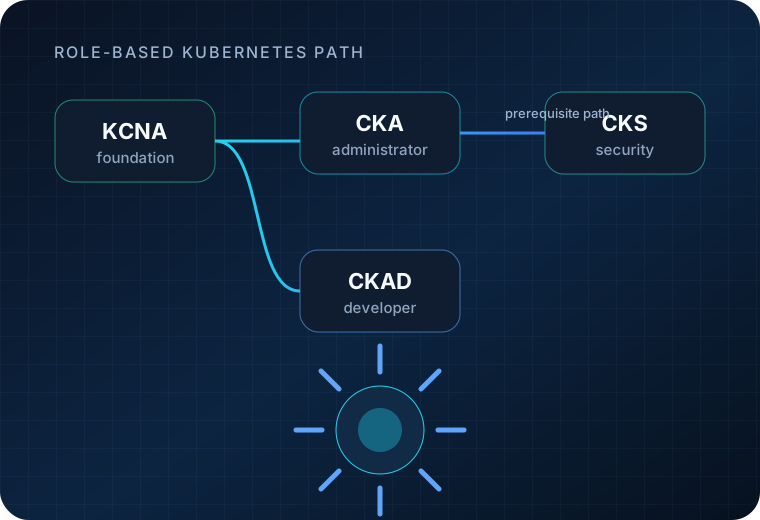
KCNA is the foundational cloud-native credential; CKA is for Kubernetes administrators; CKAD is for application developers working with Kubernetes; and CKS is the security-specialist route that currently requires you to have passed CKA before attempting the exam.
You do not need to collect them all in one fixed order.
Kubernetes certification roadmap
| Credential | Best fit | Position in the path | Assessment emphasis |
|---|---|---|---|
| KCNA | People building Kubernetes and cloud-native foundations | Associate / foundational | Foundational knowledge of Kubernetes and the wider cloud-native ecosystem |
| CKA | Kubernetes administrators and platform operators | Administrator | Performance-based cluster administration |
| CKAD | Developers building and operating applications on Kubernetes | Developer | Performance-based application-focused Kubernetes skills |
| CKS | Kubernetes security practitioners | Specialist | Performance-based security; CKA must be passed before attempting CKS |
CNCF offers additional cloud-native certifications. This site's approved Kubernetes architecture focuses on the KCNA, CKA, CKAD and CKS decision path rather than trying to create a destination for every certification in the broader catalog. For the provider-level context, see the Linux Foundation certifications guide.
Which Kubernetes certification should you take?
Choose KCNA if you need the foundation first
CNCF positions KCNA as a pre-professional certification for people building foundational Kubernetes and cloud-native knowledge.
KCNA can make sense if concepts such as Kubernetes architecture, containers, pods, nodes, clusters and the broader cloud-native landscape are still new. It gives you a structured conceptual base before you decide whether administration, development or security is the real target.
Choose CKA if you administer clusters
CKA is the administrator credential. The current exam is performance-based and focuses on hands-on Kubernetes administration.
Choose it when your work involves cluster architecture, installation and configuration, workloads and scheduling, services/networking, storage and troubleshooting.
For current exam facts, see the CKA certification guide.
Choose CKAD if you build applications on Kubernetes
CKAD is the developer route. It is designed around the skills needed to design, build, configure and expose cloud-native applications for Kubernetes.
The distinction from CKA is job ownership: CKA centers on administering the platform; CKAD centers on the applications running on it.
Choose CKS if Kubernetes security is the goal
CKS is a specialist security certification. Current CNCF/Linux Foundation policy requires a candidate to have passed CKA before attempting CKS.
That makes CKA → CKS a true prerequisite progression.
What order should you take KCNA, CKA, CKAD and CKS?
There are several valid paths.
Administrator path
KCNA → CKA → CKS
KCNA is useful when you need foundational context. CKA is the core administrator credential. CKS follows if security is part of your role or target.
If you already administer Kubernetes comfortably, KCNA is not required before CKA.
Developer path
KCNA → CKAD
KCNA can establish the cloud-native foundation; CKAD then validates application-focused skills.
Again, KCNA is a learning-path choice, not a mandatory prerequisite.
Experienced administrator path
CKA → CKS
If you already have the foundational knowledge and operate clusters, this is the direct administration-to-security progression.
Should you take KCNA or CKA first?
Take KCNA first if you need conceptual grounding.
Take CKA first if you already work with Kubernetes and can practice hands-on administration tasks such as cluster configuration, workloads, services/networking, storage and troubleshooting.
The difference is not simply “easy exam versus hard exam.” The certifications validate different levels and types of skill.
Where does Linux fit?
Kubernetes runs on systems and uses networking, storage, processes and security concepts that benefit from Linux fluency. But a Linux certification is not a formal prerequisite for CKA.
If you need stronger operating-system administration before specializing in Kubernetes, compare Linux options in the Linux certification guide. If you specifically want a hands-on Linux administration credential, see LFCS.
Current CARE renewal paths
CARE can affect how a certification path is maintained after you earn it.
As of 2026-09-30:
- If you previously earned KCNA, earning or recertifying CKA or CKAD on or after January 1, 2026 can automatically update KCNA to current status and align expiration dates.
- If you previously earned CKA, earning or recertifying CKS on or after June 18, 2026 can automatically renew or reinstate CKA.
CARE does not give you a lower-level certification you never earned.
Because these rules are new and date-specific, recheck the current CARE page when planning renewal.
A decision rule that avoids certification collecting
Before buying an exam, write down the work you want to be able to do.
- “I need Kubernetes vocabulary and architecture basics.” → KCNA
- “I need to administer and troubleshoot clusters.” → CKA
- “I build applications that run on Kubernetes.” → CKAD
- “I secure Kubernetes platforms and workloads.” → CKS after CKA
That keeps certification aligned with actual skill development.
Explore official learning paths
If you want provider-organized training pathways after choosing your Kubernetes direction, Linux Foundation Education maintains learning paths across its training catalog. This destination is a learning-path hub, not exam registration for a specific credential.
Affiliate disclosure: If you use this link, this site may earn a commission from a qualifying purchase. Merchant pricing, product contents, availability and other terms can change; verify the destination before purchase.
Sources and freshness
Certification positioning, prerequisites and CARE pathways were last verified 2026-09-30 from first-party sources:
- CNCF — Cloud Native Certifications
- CNCF — Training & Certification
- Linux Foundation Education — CKA certification
- Linux Foundation Education — Certification FAQ
- Linux Foundation Education — CARE Program
Program structure, prerequisites and renewal rules can change. Reverify before purchase or recertification decisions.
Last verified: .