
Linux Foundation Certifications: Which One Should You Take?
Choose a Linux Foundation certification by the skill set you want to validate, not by trying to complete every credential.
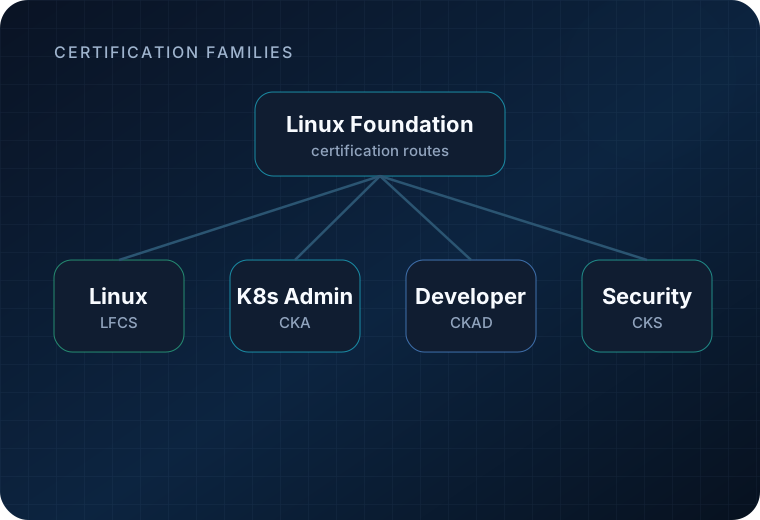
For Linux system administration, LFCS is the direct hands-on route. For cloud-native work, CNCF and The Linux Foundation offer Kubernetes credentials that separate foundational knowledge, cluster administration, application development and security.
This site's current certification architecture focuses on Linux administration and the Kubernetes path. Linux Foundation Education offers additional certifications beyond the pages covered here.
The main routes covered on this site
| Route | Credential | Best fit | Assessment emphasis |
|---|---|---|---|
| Linux administration | LFCS | Linux system administrators | Hands-on, performance-based Linux administration |
| Kubernetes foundation | KCNA | Learners building cloud-native foundations | Foundational Kubernetes/cloud-native knowledge |
| Kubernetes administration | CKA | Cluster administrators and platform operators | Hands-on Kubernetes administration |
| Kubernetes application development | CKAD | Developers building and operating apps on Kubernetes | Hands-on application-focused Kubernetes skills |
| Kubernetes security | CKS | Practitioners securing Kubernetes environments | Hands-on Kubernetes security; CKA must be passed before attempting CKS |
For current pages available in this batch, see the LFCS guide, Kubernetes certifications guide, and CKA guide.
Which Linux Foundation certification should you take?
If you administer Linux systems: start with LFCS
LFCS validates Linux system-administration skills through an online, proctored, performance-based exam. It is currently distribution-agnostic and has no prerequisite.
Choose it when the job you want involves Linux operations: processes and services, networking, storage, users and groups, troubleshooting, software management, and related administration work.
If you are new to Kubernetes and cloud native: consider KCNA
CNCF positions KCNA as an associate-level, foundational Kubernetes and cloud-native credential. It is designed to establish conceptual knowledge before or alongside deeper professional certifications.
KCNA can be useful when you need a structured foundation, but it is not a prerequisite for CKA or CKAD.
If you administer Kubernetes clusters: choose CKA
CKA is the administrator credential in the Kubernetes certification family. CNCF and The Linux Foundation use a performance-based exam where candidates solve tasks from the command line.
If this is your target, continue to the CKA certification guide.
If you build applications for Kubernetes: CKAD is the developer route
CKAD targets application-focused Kubernetes skills rather than cluster-administration ownership. That distinction matters: a developer and a cluster administrator can work on the same platform while needing different certification outcomes.
If you want Kubernetes security: CKS is the specialist route
CKS is a performance-based security credential. Current policy requires candidates to have passed CKA before attempting CKS.
That makes the administration-to-security progression a real prerequisite relationship, not just a suggested learning path.
How Linux Foundation certification renewal works
Certification lifecycle details can change, so verify the current policy before relying on a renewal route.
Linux Foundation's certification FAQ states that candidates may keep a certification current by retaking and passing the certification exam before it expires.
In 2026, Linux Foundation also fully implemented CARE — Certification Advancement & Recertification Experience. CARE lets an eligible higher-level achievement automatically renew certain previously earned lower-level credentials.
Current CARE examples relevant to this site's topic include:
- A previously earned KCNA can be renewed when you achieve or recertify CKA or CKAD on or after January 1, 2026.
- A previously earned CKA can be renewed or reinstated when you achieve or recertify CKS on or after June 18, 2026.
- A previously earned LFCA can be renewed when you achieve or recertify LFCS on or after August 1, 2026.
CARE does not award a lower-level certification you never earned. It renews eligible credentials that were previously achieved.
What is CARE?
CARE stands for Certification Advancement & Recertification Experience. It is Linux Foundation's program for recognizing progression: when you earn or recertify an eligible higher-level credential, qualifying foundational certifications you already earned can automatically update to current status and align their expiration dates.
Because the program has effective-date rules and credential-specific pathways, treat it as a freshness-controlled policy. Check the Linux Foundation CARE page before making a recertification decision.
A simple way to choose
Use role first:
- Linux system administrator: LFCS
- Kubernetes/cloud-native beginner: KCNA
- Kubernetes administrator: CKA
- Kubernetes application developer: CKAD
- Kubernetes security specialist: CKS after CKA
If you are still deciding between Linux administration and cloud-native administration, return to the Linux certification guide.
Browse current Linux Foundation certifications
After choosing the skill path that fits your role, you can review Linux Foundation Education's current certification catalog. The destination is the provider catalog rather than a specific certification product.
Affiliate disclosure: If you use this link, this site may earn a commission from a qualifying purchase. Merchant pricing, product contents, availability and other terms can change; verify the destination before purchase.
Sources and freshness
Last verified 2026-09-30 from first-party sources:
- Linux Foundation Education — LFCS certification
- CNCF — Cloud Native Certifications
- CNCF — Training & Certification
- Linux Foundation Education — CARE Program
- Linux Foundation Education — Learning Paths
Renewal rules, prerequisites, product inclusions and certification positioning are freshness-controlled. Reverify before purchase, recertification or deployment.
Last verified: .